

Programmable Doping in Epitaxial Graphene Devices
Graphene grown epitaxially on silicon carbide (SiC) addresses many problems that have precluded the realization of a scalable platform of graphene devices. This growth method allows for wafer-scale growth of low-density material, giving it distinct advantages over chemical vapor deposition or exfoliation. One issue associated with SiC graphene that had not been addressed was the strong, intrinsic n-doping, making the charge neutrality point inaccessible by electrostatic gating alone.
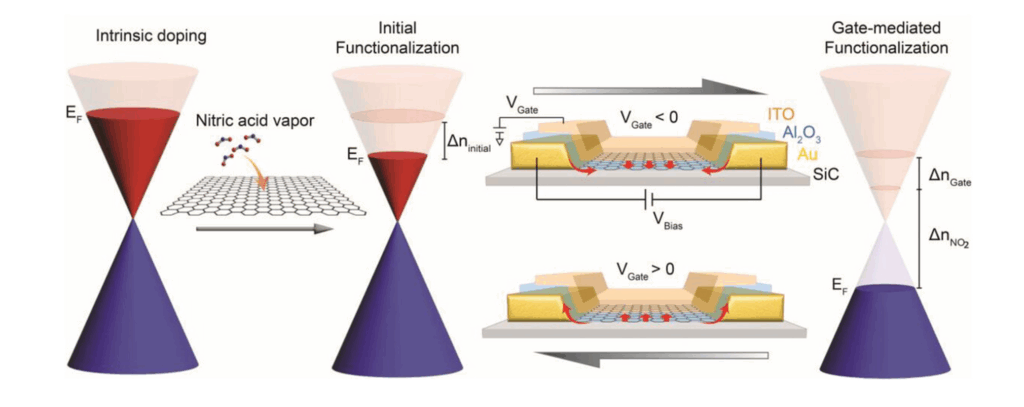
A Georgetown team led by graduate student Yijing Liu (Ph.D., 2025), has demonstrated a breakthrough method of compensating for this n-doping by encapsulating molecular dopants under a dielectric layer. Field-effect transistors with epitaxial graphene channels were patterned using lithographic methods, and the channels were exposed to nitric acid vapor before deposition of Al2O3 by atomic layer deposition. The alumina layer prevents desorption of molecules and allows for electrostatic gating via a top-gate.
Surprisingly, the degree of molecular doping in these devices is variable and can be controlled by the gate voltage. Once the desired molecular doping level is achieved, it can be fixed by cooling the device below 240 K, resulting in a programmable effect where the doping level can be tuned between electron-doped, charge-neutral, and hole-doped. This level of control shows significant promise for scalable implementations of graphene-based devices.
This research was conducted in collaboration with Georgetown Ph.D. candidates DaVonne Henry and Alexis Demirjian, and professors Paola Barbara and Amy Liu, along with Nikolai Kalugin’s group at New Mexico Tech, and Curt Richter and Albert Rigosi’s group at NIST. A paper entitled “Gate-Assisted Programmable Molecular Doping of Epitaxial Graphene Devices” has recently been published in the journal Small Methods.