

New DARPA grant to study ultra-low-power magnetic memory
Posted in News Story
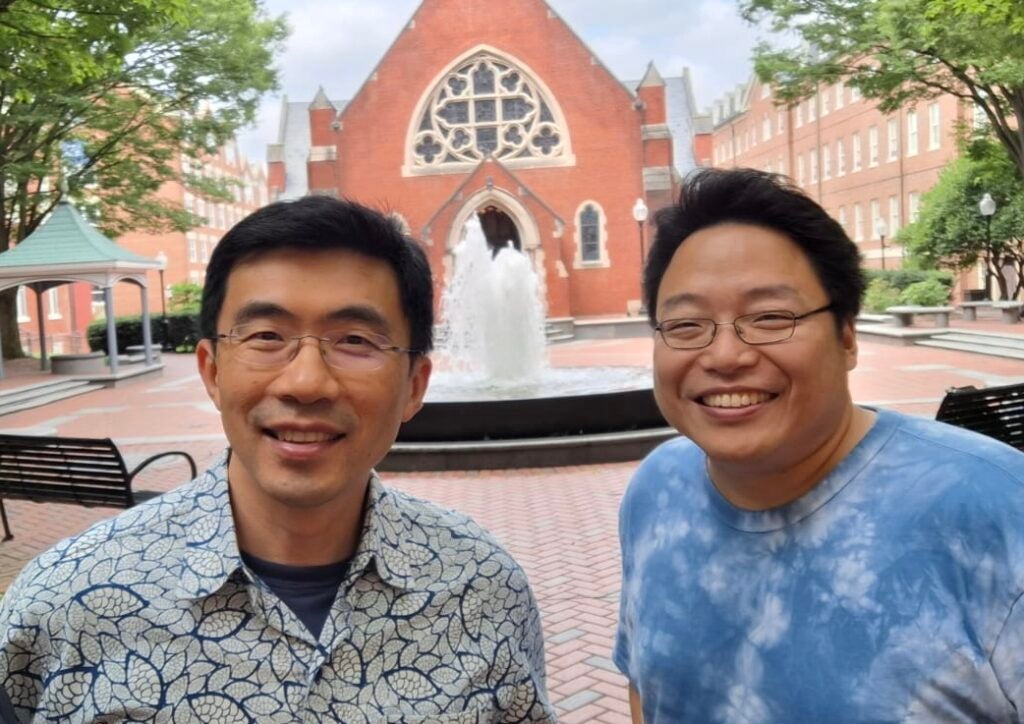
A team led by Prof. Kai Liu has been awarded a research grant from the Defense Advanced Research Projects Agency (DARPA) to study a novel class of data storage technology. The interdisciplinary team of researchers, including Prof. Gen Yin (Georgetown University), Prof. Dhritiman Bhattacharya (Rowan University) and Olivia Amivi (Nano Bird LLC), aims to overcome the fundamental physical limitations of modern digital storage by developing ultra-low-power, high-speed, and high-density magnetic “skyrmionic” memory devices.
Modern data storage solutions, such as random-access memory and flash memory, are reaching their physical limits. They face severe trade-offs between speed, energy efficiency, and storage density limitations that severely hinder computing performance in extreme, resource-constrained environments. The Georgetown-led project proposes a radical shift: instead of using inefficient electric currents and the associated Joule heating, the team will utilize a new type of information carriers called magnetic skyrmions and use an electric field to manipulate them. Magnetic skyrmions are microscopic, swirling magnetic configurations, like nanoscale twisters. They possess fascinating topological characters that make them stable and energy-efficient hosts of digital information.
“Our goal is to build a proof-of-concept device that demonstrates a new way to store information that may address the energy dissipation plaguing current memory technologies,” said Dr. Kai Liu, Professor and McDevitt Chair in Physics at Georgetown University. “By using an electric field to control how certain ions migrate in our device, we hope to dial up the skyrmion topology on-demand, opening the door to nonvolatile memory that operates with exceedingly low energy requirements.”
The project builds upon groundbreaking work by Prof. Liu’s group. The technology that they will use in the new project is available for licensing and strategic partnerships to support further development through the Georgetown University Office of Technology Commercialization, which has supported multiple patent applications of Prof. Liu and his collaborators.
Read more here about the foundational work and related technology here: