

2026 Mayer Scholarship Recipients
Posted in News Story
The Department of Physics is pleased to announce that Raheen Iqbal and Colin Langton are the recipients of the 2026 Professor Walter G. Mayer Endowed Scholarship, which supports graduate students pursuing a Ph.D. in experimental physics. Below please find information on Raheen and Colin’s research.
Raheen Iqbal
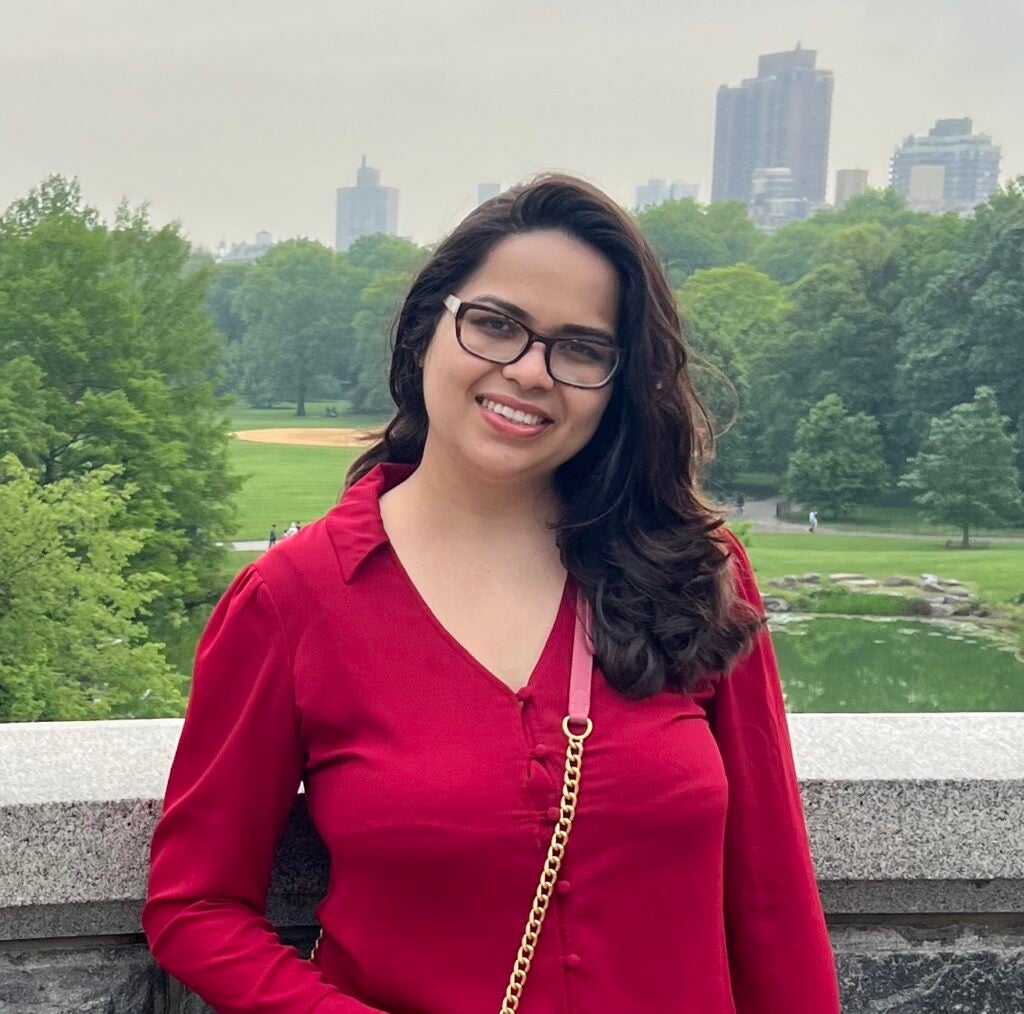
Raheen’s research explores how mixtures of polymers separate into distinct liquid regions and how small molecules can be used to control this process. Known as liquid-liquid phase separation, this phenomenon is important in both living cells and the development of new materials. Using a model mixture of polyethylene glycol (PEG) and dextran (DEX), Raheen combines microscopy, spectroscopy and other laboratory techniques to observe when separation occurs, how it develops over time, and which molecular interactions drive it. Her research has shown that adding urea can substantially lower the temperature at which the mixture separates because urea interacts more strongly with PEG. She is now studying how the polymers distribute between the resulting regions and how their local environments change as separation unfolds. She is also working to create a three-dimensional picture of how droplets form and grow and to measure how fluid each region is at the microscopic level. This work contributes to a broader understanding of how small molecules can be used to control the behavior of complex soft materials.
Colin Langton

Colin’s research explores symmetry and topology in real and momentum space to advance fundamental understanding of nanomagnetism, with potential applications in next generation spintronic memory and computing. As conventional 2D planar devices reach their physical limits, unlocking higher speeds and energy efficiency demands a shift toward complex 3D architectures and engineered materials. Colin addresses this by examining the fundamental roles of curvature and chirality in 3D systems. He investigates unique geometries such as Möbius bands and nanowire networks, opening routes to complex spin textures and novel magnetic phenomena. In addition, Colin studies candidate altermagnet materials that have unique topological characteristics in their electronic structure as a high-performance alternative to traditional ferromagnetic architectures, enabling precise control directly at the material level.