

Mohsen Yarmohammadi and James K. Freericks published the first theoretical demonstration of cavity-induced magnetization in altermagnets in Physical Review Letters
Posted in News Story
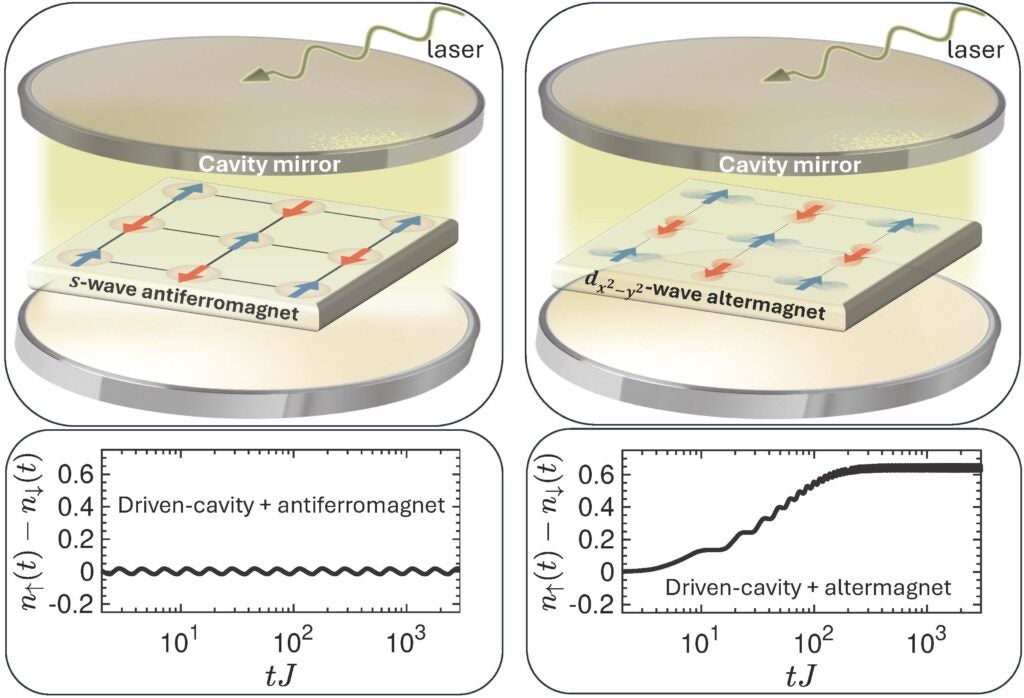
James K. Freericks and Mohsen Yarmohammadi published the first theoretical demonstration of cavity engineering in altermagnets. Imagine a material that behaves like a ferromagnet with strong spin splitting of its electronic bands but carries zero net magnetization, just like an antiferromagnet. That seemingly impossible combination is exactly what altermagnets deliver. Discovered theoretically in 2022 and now rapidly moving into experiments, altermagnets are a third fundamental class of magnets. This unique property makes altermagnets ideal for next-generation spintronic and orbitronic devices: ultrafast, energy-efficient, and stray-field-free. However, many practical spintronic operations require a finite, controllable magnetization to switch or store information reliably.
In a recent landmark paper published in Physical Review Letters (https://link.aps.org/doi/10.1103/7bss-9yxb), Georgetown physicists, working in collaboration with altermagnet co-inventor Libor Šmejkal, demonstrate how the unique properties of altermagnets can be harnessed for practical applications. By placing a 2D altermagnet inside a THz laser-driven cavity, they theoretically demonstrate that asymmetrical light–matter coupling can induce a finite, controllable magnetization on demand—something impossible in conventional antiferromagnets because they lack the required momentum-dependent spin texture. The effect is purely reversible and operates on ultrafast timescales.